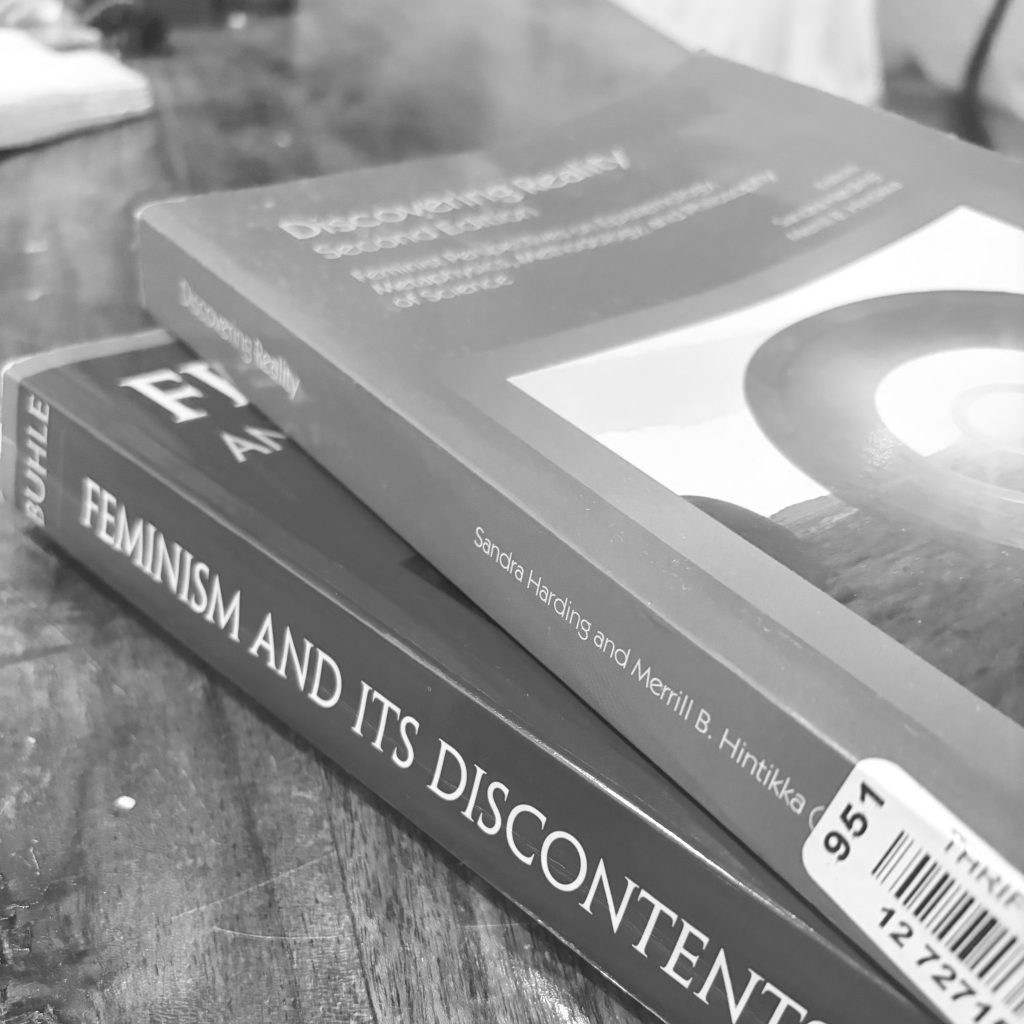
It was late spring in Toronto when, in the depth of writing a paper engaging with Avgi Saketopoulou’s work, I came across a paragraph and a footnote in Donna Haraway’s Situated Knowledges: The Science Question in Feminism and the Privilege of Partial Perspective. The paragraph goes:
Some of us tried to stay sane in these disassembled and disassembling times by holding out for a feminist version of objectivity. (…) Marxist starting points offered a way to get to our own versions of standpoint theories, insistent embodiment, a rich tradition of critiquing hegemony without disempowering positivisms and relativisms and a way to get to nuanced theories of mediation. Some versions of psychoanalysis were of aid in this approach, especially anglophone object relations theory, which maybe did more for U.S. socialist feminism for a time than anything from the pen of Marx or Engels, much less Althusser or any of the late pretenders to sonship treating the subject of ideology and science. (Footnote 5)
Haraway, Situated Knowledge, 578
What, I asked myself, could object relations have done for feminist epistemology?
Quite a bit, as it turns out. The footnote (footnote 5) is one I will return to a lot. I had known about Haraway since an upper year seminar in undergrad but this footnote points me to new names: Sandra Harding, Evelyn Fox Keller, Nancy Hartsock. After looking up a few PDFs and scouring the net for some background, I simultaneously order a copy of Discovering Reality: Feminist Perspectives on Epistemology, Metaphysics and Philosophy and spend a whole day listening to this fascinating Oral history interview with Sandra Harding.
Initially published in 1983, Discovering Reality is an odd and daring assemblage of big US department philosophical methodology, feminist lines of questioning and, most surprising to me, psychoanalysis. Harding’s own account of how this volume came to be is delightful:
We [Merrill Hintikka and Sandra Harding] had decided to put together this collection of feminist epistemology, metaphysics, methodology, and philosophy of science papers, and I think I mentioned—did I mention she was married to Jaakko Hintikka, who was a very famous, powerful philosopher, analytic philosopher and logician? He was from Finland.
And he held two very powerful positions. He was chairman of the board of the journal Synthese, and he was the editor-in-chief of the same publisher book series called Synthese Library. So, he had promised Merrill and me a special issue of Synthese. And when the board heard the title, Discovering Reality: Feminist Perspectives and so forth, they ran amok. Three of them threatened to quit if that was published, and one of them [told Jaakko], “I suppose they’re going to have on the cover a photograph of Betty Friedan waving her bra.” It was a crisis.
And so, he gave us—he was very annoyed. He was very feminist. He gave us a volume in the Synthese Library series, and that’s what this is. It’s Volume 83 in the series.
I must admit that the thought of this analytic philosopher suffering a crisis is at least as funny as it is despairing. But what I also imagine is that the big reaction to the arrival of feminist ideas in this specific type of philosophy department distracted from the more subdued but certainly present engagement with psychoanalysis in this volume.
Several of the papers in Discovering Reality directly engage with psychoanalysis, and specifically a version of object relations put forward by Nancy Chodorow in The Reproduction of Mothering; another essential volume that this research took me towards. I won’t reconstruct Chodorow’s argument here, but for more on the context of her work, I highly recommend reading either Chodorow or the excellent Feminism and Its Discontents: A Century of Struggle with Psychoanalysis by Mari-Jo Buhle (one of my favourite discoveries of the summer so far). But in short, I would say that feminist epistemologists turn to object relations as a resource to introduce relationality in questions of knowledge, and to move away from a disembodied, third-party conception of objectivity. Fairbairn’s claim that we are fundamentally object seeking complements other important ideas of continental and later postmodern philosophy such as Husserl’s notion of intentionality.
This initially surprising encounter of different traditions of thought has been with me for the last few weeks; I am particularly glad to have come across Jane Flax’s (one of the authors mentioned in Haraway’s fifth footnote) contention that:
I think there are currently three kinds of thinking that best present (and represent) our own time “apprehended in thought”: psychoanalysis, feminist theory, and postmodern philosophy.
Flax, Postmodernism and Gender Relations in Feminist Theory, 622
I think Flax is right, and I plan to come back to this topic in greater detail. What I will leave with for now is the idea that this triangular configuration involves, as I have hinted at a few times, a certain version of psychoanalysis, namely object relations. The tradeoff, as I see it, is something like: relationality for sexuality. There is perhaps no better example of this than Haraway’s paper which started this inquiry; a feminist paper, with a distinctly postmodern approach (call it correlationist), well anchored in psychoanalysis. A paper which shines in thinking about relationality, dependence and vulnerability, all strong suits of object relations. And yet, a paper almost entirely focused on vision without once engaging with one of the earliest questions of psychoanalysis: voyeurism and autoerotic pleasure.

